

Lawn Care Mowing Service: What It Is and What It Includes
You're tired of mowing on Saturday mornings, or your last hire showed up twice then vanished. Either way, you're trying to figure out what a lawn care mowing service actually covers before you hand over your credit card or your yard's future to a stranger with a trailer.
Here's the short answer: a real mowing service does more than cut grass. It includes mowing and edging on a set schedule, trimming around beds and fences, blowing off clippings from walkways and driveways, and usually a quick check for problem spots like bare patches or drainage issues. Some companies bundle it with fertilization or weed control, others keep it separate. Knowing which is which matters when you're comparing quotes from three different crews in Columbia or Blythewood.
In this article, we'll break down exactly what's included in a standard mowing visit, what typically costs extra, how pricing works for residential vs. commercial properties , and what questions to ask before you book. We'll also cover what separates a dependable local crew from a truck-and-mower operation that won't last the season.
Why hiring a lawn care mowing service pays off
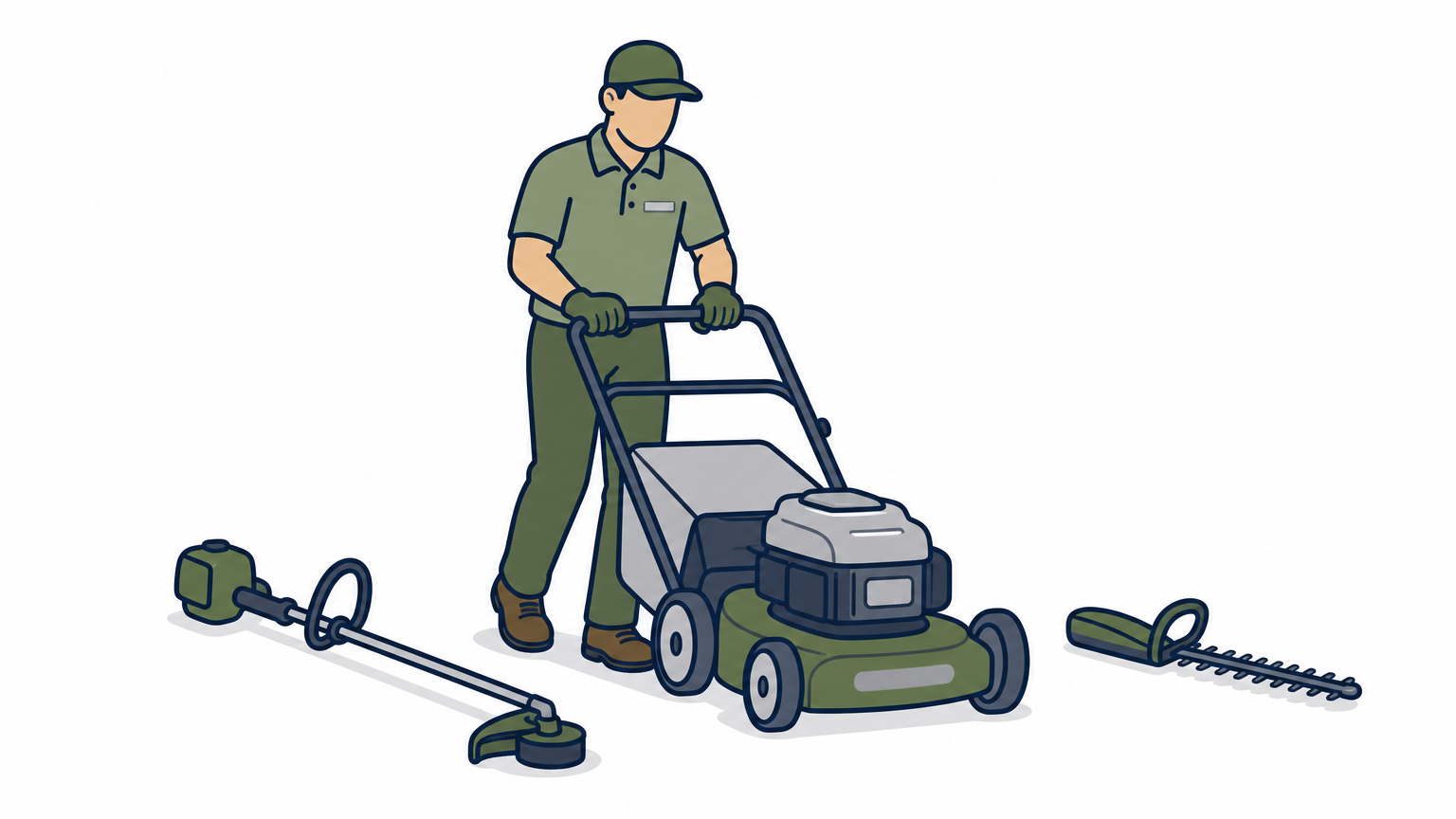
Most homeowners underestimate how much a weekly mow actually costs them in time and money once you add up the labor. Cutting, edging, and trimming a typical quarter-acre lot yourself takes 45 minutes to over an hour, and that's before you factor in bagging clippings or fixing a mower that won't start. A professional lawn care mowing service hands that block of time back to you every single week, which adds up to dozens of hours over a full growing season.
Your lawn looks better, consistently
Beyond time, consistency is what actually protects your lawn's health and your property's curb appeal. A crew that shows up on the same day each week, cutting at the right height for your grass type, prevents the scalping and stress that comes from letting grass grow too tall between infrequent cuts. Neighbors notice a lawn that's mowed on a predictable schedule, and so do potential buyers if you're ever selling. HOA boards notice too, since overgrown grass is one of the most common violation notices sent to homeowners in the Midlands.
A lawn mowed on a consistent schedule by an experienced crew almost always outperforms one mowed inconsistently by an owner with good intentions.
You skip the equipment headaches
Owning a mower that can actually keep pace with South Carolina's warm-season grasses isn't cheap, and neither is keeping it running. Blades dull fast in our clay-heavy soil, engines need seasonal tune-ups, and a mower that sits unused for four months over winter often needs a battery or carburetor fix come spring. Hiring out residential lawn care means you never touch a spark plug or haul a bag of clippings to the curb again.
Here's a rough side-by-side of what property owners typically spend either way:
| Cost Category | DIY Mowing (Annual) | Professional Service (Annual) |
|---|---|---|
| Equipment purchase/replacement | $300-$1,200 | $0 |
| Fuel and oil | $80-$150 | $0 |
| Blade sharpening/repairs | $100-$250 | $0 |
| Your labor (30 weeks x 1 hr) | 30+ hours | 0 hours |
| Weekly service fee | $0 | $1,200-$2,000+ |
Once you price in your own time at even a modest hourly rate, the gap between DIY and hiring a crew shrinks fast, and for a lot of homeowners it disappears entirely.
Expertise you can't get from a big-box mower
Grass in Columbia, Blythewood, and Elgin behaves differently than grass in Charlotte or Atlanta, and a crew that works this specific climate every day knows how centipede and Bermuda respond to our humidity, clay soil, and summer thunderstorms. That local knowledge shows up in small decisions, like adjusting mowing height during a drought or catching early signs of lawn fungus before it spreads. Sparta Lawn Care's crews handle residential lawn care services in the Midlands with that exact kind of property-specific attention, which is the difference between a lawn that survives summer and one that thrives through it.
Finally, there's the guarantee factor. Reputable companies stand behind the work, so if a crew misses a spot or damages a bed edge, they come back and fix it at no charge. That accountability is worth more than the mowing itself, because it means you're not gambling on whether this week's visit goes well.
What a typical mowing visit includes
Walk out to your yard on service day and you should see more than a crew running a mower back and forth. A proper mowing service in Columbia and the Midlands treats each visit as a full pass on the property, not just a quick cut and go. Understanding what's baked into a standard visit versus what gets billed separately saves you from surprise charges later, and it gives you a real benchmark when you're comparing quotes.
The core tasks included in every visit
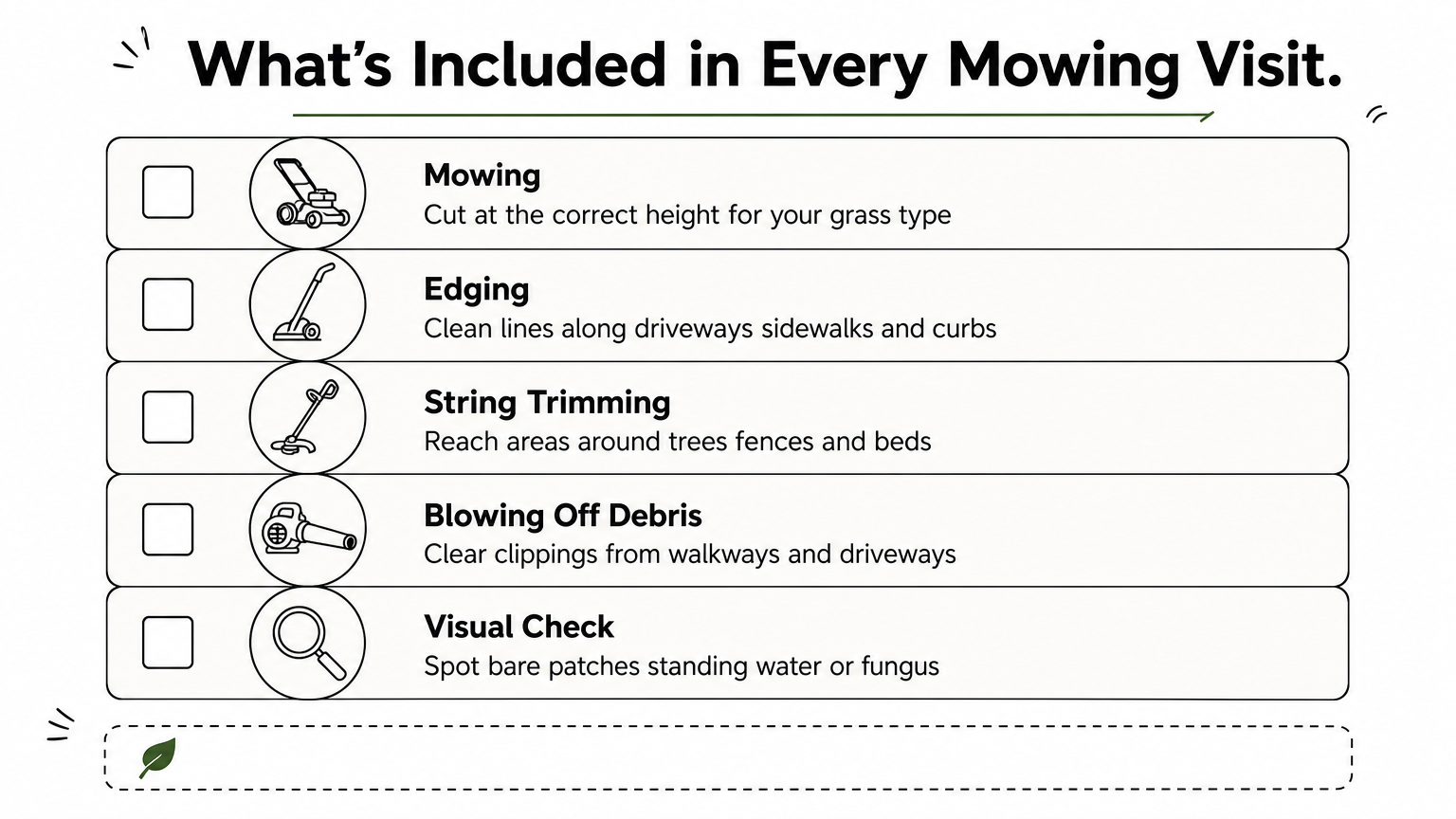
Most established companies build their standard visit around the same core checklist, even if the order changes crew to crew. Here's what should be covered every time:
- Mowing at the correct height for your grass type (centipede, Bermuda, zoysia, or fescue all have different ideal cutting heights)
- Edging along driveways, sidewalks, and curbs for a clean line
- String trimming around trees, fences, mailboxes, and flower beds where a mower can't reach
- Blowing off clippings and debris from hardscapes so nothing's tracked into your house or pool
- A quick visual check for problem spots like bare patches, standing water, or fungus
The best lawn mowing services treat edging, trimming, and cleanup as part of the mow, not as an upsell.
What typically costs extra
Bagging clippings instead of mulching them back into the lawn is a common add-on, especially in spring when growth is fast and clumping is a problem. Leaf removal in fall, storm cleanup after a big wind event, and one-time overgrown lot cleanups also usually fall outside the standard visit. Fertilization, weed control, and aeration and overseeding are almost always billed as separate services, since they run on their own seasonal schedule rather than a weekly cadence. If you're unsure whether something's included, ask upfront rather than assuming, since this is where a lot of price confusion starts between homeowners and crews.
Commercial and HOA visits look a little different
Properties with common areas, retention ponds, or large parking lot islands need a broader scope than a residential yard. Crews servicing commercial lawn care and maintenance contracts often handle bed maintenance, sign line trimming, and debris removal from parking areas as part of the same visit, since these properties get judged on overall grounds appearance, not just grass height. HOA boards in particular expect a consistent standard across every common area, which is why a crew-based model with a familiar team matters more here than it does for a single residential yard.
How to choose the right lawn care mowing service
Vetting a lawn care company shouldn't feel like a coin flip. You're trusting someone with a key visible asset on your property, so a few minutes of vetting upfront saves you from a bad contract later. Start with the basics: is the company licensed and insured , and how long have they actually operated in your area? A truck-and-mower operation that popped up last spring can't match a company with 20 years of history in Columbia, Blythewood, and Elgin.
Look for a consistent crew model
Ask whether you'll get the same crew every visit or a rotating cast of subcontractors. A consistent crew from a mowing service near you learns your property, your gate codes, your dog, and your problem spots, which means fewer mistakes over time. Rotating crews mean you're re-explaining the same details every few weeks, and quality slips because nobody owns the outcome.
A crew that knows your property by name almost always outperforms one that shows up cold every visit.
Check the guarantee and communication style
Find out what happens when something goes wrong. Does the company fix missed spots or damaged beds at no charge, or do you have to argue for a redo? Sparta Lawn Care backs every visit with the guarantee that keeps homeowners with us, meaning any service issue gets corrected until you're satisfied, no extra invoice involved. Also check how they handle scheduling and payments. A company running everything through a modern client hub, like Jobber, with online credit card payments, saves you from chasing invoices or waiting on a paper check to clear.
Compare quotes apples to apples
When you're gathering estimates, use a short checklist so you're comparing the same scope every time:
- Does the quote include edging, trimming, and blowing, or just mowing?
- Is bagging included or billed separately?
- What's the cancellation or pause policy for vacations?
- Are fertilization and weed control bundled or add-on?
- Who do you call if a visit gets missed?
Read reviews with a critical eye
Finally, read reviews with an eye toward specifics, not star counts. A handful of five-star reviews that mention punctuality, clean equipment, and responsive communication are signs you've found the right mowing crew, and they tell you more than a hundred generic ratings. Companies that serve commercial lawn care and maintenance contracts alongside residential yards, like Sparta Lawn Care, usually carry a higher standard of professionalism across the board, since HOA boards and property managers hold them to stricter accountability than a single homeowner might.
How much does a lawn mowing service cost
Price is usually the first question homeowners ask, and the honest answer on what a lawn care service costs is: it depends on lot size, terrain, and how many extras you bundle in. A lawn care mowing service for a typical quarter-acre to half-acre residential lot in the Midlands runs somewhere between $40 and $75 per visit, with most homeowners landing in the $45-$60 range for a standard weekly or biweekly cut. Larger lots, steep grades, heavy tree cover, or lots of edging around beds push that number higher.
What drives the price up or down
Several factors shift the quote you'll get, and understanding them helps you spot a fair price versus a lowball that'll get renegotiated after the first visit.
| Factor | Effect on Price |
|---|---|
| Lot size (under 1/4 acre vs over 1/2 acre) | Larger lots cost more per visit |
| Terrain (flat vs sloped or wooded) | Slopes and obstacles add time and cost |
| Frequency (weekly vs biweekly) | Weekly visits often cost slightly less per cut |
| Bagging clippings | Usually adds $10-$20 per visit |
| Bundled services (fertilization, aeration) | Lowers per-visit cost when packaged together |
The lowest quote rarely stays the lowest once bagging, edging, and cleanup get added back in.
Weekly vs monthly billing
Budgeting gets easier when you understand how billing usually works. Most companies quote per visit but bill monthly, averaging out the weeks so your payment stays steady even during months with five mowing weeks instead of four. Ask upfront whether your quote is per cut or a flat monthly rate, since the two can look identical on paper but land differently on your bank statement in a five-week month.
Commercial and HOA pricing works differently
Contracts covering commercial mowing for business properties or HOA common areas get priced by total square footage and scope rather than a flat per-visit rate, since these properties often include retention ponds, parking islands, and multiple buildings. Property managers should expect a detailed proposal breaking out mowing separately from bed maintenance, so there's no ambiguity about what's covered month to month.
Finally, remember that the cheapest quote isn't always the best value. A crew that skips edging or blows debris into the street to save five minutes will cost you more in redo requests than you save upfront. Pair your price comparison with the scope checklist from the section above, and factor in whether fertilization and weed control services are worth bundling in for a better combined rate.
How often your lawn should be mowed
Grass doesn't grow on a fixed calendar, so the right mowing frequency shifts with the season and the type of turf in your yard. During peak growing months, April through September in the Midlands, most warm-season lawns need a cut every 5 to 7 days to keep pace with growth. Mowing frequency for Columbia lawns slows to every 10 to 14 days in spring and fall as growth tapers off, and most lawns barely need cutting at all during winter dormancy.
Grass type changes the schedule
Columbia and Blythewood yards are mostly centipede, Bermuda, zoysia, or St. Augustine, and each one responds differently to cutting height and frequency. Bermuda grows fast and tolerates a low cut, so it often needs weekly attention in summer. Centipede grows slower and prefers a higher cut, so biweekly service works for a lot of homeowners once the lawn is established.
| Grass Type | Peak Season Frequency | Ideal Mowing Height |
|---|---|---|
| Bermuda | Weekly | 1-1.5 inches |
| Centipede | Weekly to biweekly | 1.5-2 inches |
| Zoysia | Weekly | 1-2 inches |
| St. Augustine | Weekly | 2.5-4 inches |
The one-third rule matters more than the calendar
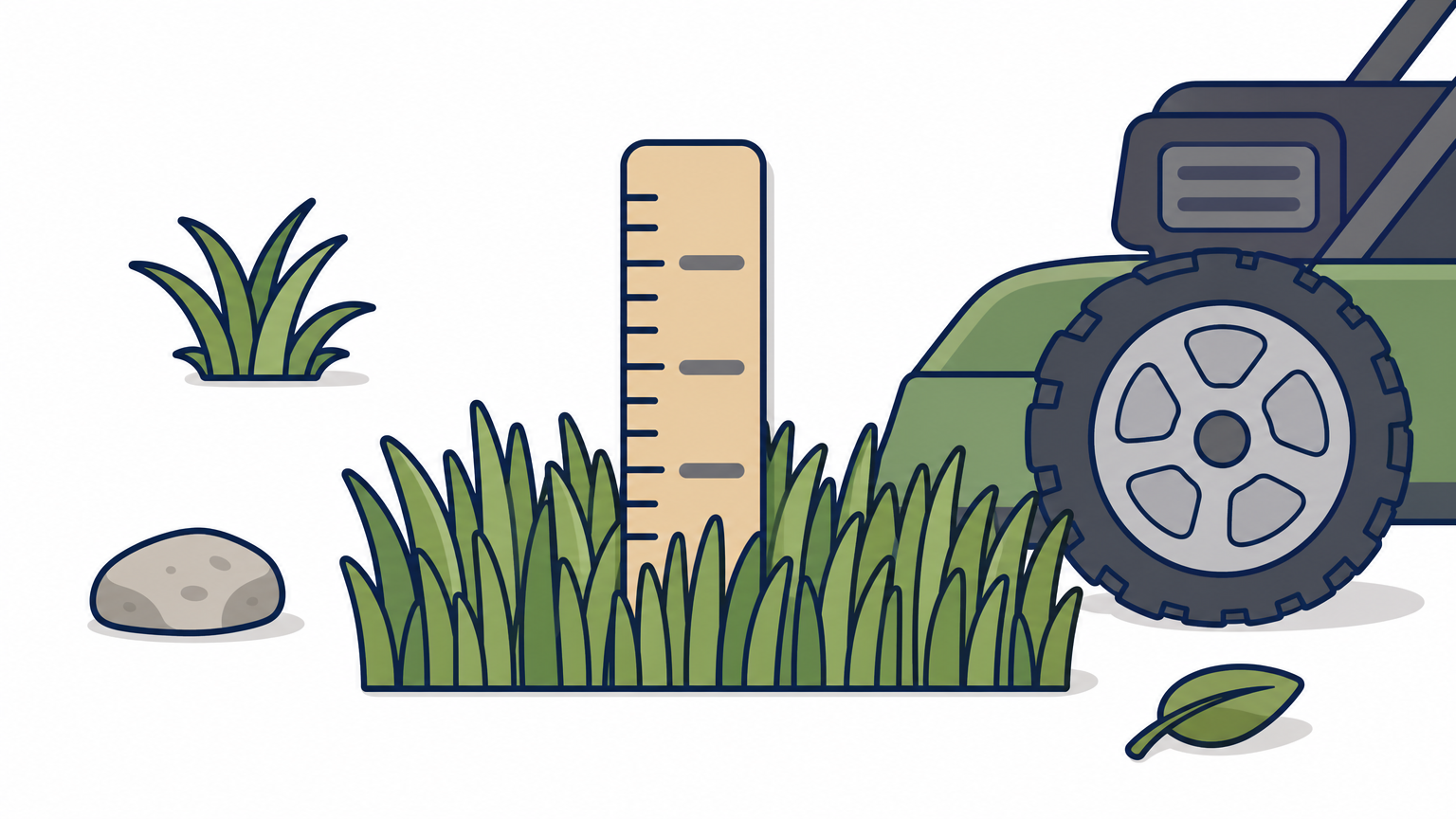
Rather than mowing on a strict date, the better rule is never cutting more than one-third of the blade height in a single pass. Skipping a week and then scalping the lawn back down stresses the grass and opens the door to fungus and weeds. This is exactly why a scheduled service beats a sporadic DIY cut, since a crew adjusts timing around actual growth rather than whatever Saturday you happen to be free.
Cutting off more than a third of the blade in one pass stresses the lawn more than skipping a week ever will.
Weather throws off the schedule too
South Carolina summers bring heavy rain some weeks and drought stress in others, both of which change how fast grass grows. A good crew watches the weather and adjusts visit timing rather than mowing on autopilot regardless of conditions. Pairing your mowing schedule with fertilization timed to the growing season also keeps growth more even, so you're not caught between a lawn that grew four inches in a week and one that barely moved.
Questions to ask before you hire a crew
Before any crew sets foot on your property, run through a short list of questions that separates a professional operation from a side hustle with a trailer. Getting clear answers upfront prevents the awkward mid-season conversation where you're suddenly billed for something you assumed was included. A lawn care mowing service worth hiring will answer these without hesitation, since they've fielded them a thousand times before.
Questions about credentials and reliability
Start with the basics that protect you if something goes wrong on your property. Ask directly:
- Are you licensed and insured, and can you send proof?
- How long have you operated in Columbia, Blythewood, or Elgin specifically?
- Will I get the same crew every visit, or does that rotate?
- What happens if a crew member damages a fence, sprinkler head, or bed edge?
- Do you carry workers' compensation coverage for your crew?
Getting a straight answer on insurance matters more than any other question on this list, since an uninsured crew that damages your irrigation system leaves you covering the repair yourself.
If a company hesitates to answer questions about insurance or crew consistency, treat that hesitation as your answer.
Questions about scope and scheduling
Hesitation on pricing questions is a different kind of warning sign, one that shows up more in cost disputes than in property damage. Nail down exactly what's included before you sign anything:
- Does the quote include edging, trimming, and blowing, or is mowing the only line item?
- What's your policy on rescheduling around rain?
- How do you handle vacation holds or temporary pauses?
- Is bagging included, or billed as an add-on?
- Do you offer Lawn Care Fertilization & Weed Control Treatments as a bundled package, or is that a separate contract entirely?
Questions about your specific property round out the list, since a generic answer here usually means the company hasn't actually looked at what your lawn needs. Push for specifics: what grass type do they think you have, what height will they cut at, and how will that change between June and October? A crew that can answer confidently, using your actual grass type and yard conditions rather than a canned response, is telling you they've done this enough times to know the difference. That kind of specificity is exactly what separates a company that treats your yard as one stop on a route from one that treats it as a property they intend to keep for years.
Putting it all together for your lawn
A good lawn care mowing service isn't just someone with a mower and a Saturday morning free. It's mowing and edging on a set schedule, trimming and cleanup handled every visit, pricing you can actually predict, and a crew that learns your property instead of treating it like a random stop on a route. Once you know what belongs in a standard visit, what costs extra, and which questions expose a shaky operation, comparing quotes gets a lot less confusing.
Columbia, Blythewood, and Elgin homeowners deal with the same clay soil, humidity, and warm-season grass challenges every summer, and that's exactly the kind of local knowledge worth paying for. If you're ready to stop guessing and hand your yard to a crew that's been doing this in the Midlands for over 20 years, get a real mowing quote for your property from Sparta Lawn Care.