

Lawn Care Service: What It Is and What It Costs
You're tired of mowing on weekends, or you've watched a neighbor's yard look sharp all season while yours falls behind. Either way, you're probably searching for a lawn care service that actually shows up on schedule and does the job right, and you want to know what it's going to cost before you pick up the phone. That's a fair question, and the answer depends on more than most people expect.
A real lawn care service company does more than run a mower over your grass once a week. It covers mowing, edging, fertilization, weed control, aeration, and seasonal cleanup, all timed to how your specific turf grows through South Carolina's heat and humidity. Pricing usually falls into a range based on lot size, service frequency, and which treatments you add, and we'll break down actual numbers below.
In this article, you'll get a clear definition of what's included in professional lawn care, a breakdown of typical costs for residential and commercial properties in the Midlands, and what separates a crew-based, guaranteed service from a crew that just cuts grass and leaves.
Why hiring a professional lawn care service matters
Homeowners often think of lawn care as optional polish, something you can skip during a busy month without real consequences. That's not how turf works. Grass in the Midlands grows on a tight biological schedule tied to temperature, rainfall, and soil chemistry, and missing even one or two treatment windows can set your yard back for the rest of the season. A professional lawn care service exists to hit those windows consistently, which is something a rotating cast of neighborhood kids or a sporadic DIY schedule almost never manages.
A lawn that gets consistent, correctly timed care looks better with less total effort than one that gets occasional bursts of attention.
Consistency beats occasional effort
Consider what happens when mowing, edging, and fertilization all happen on the same predictable schedule instead of whenever someone finds free time. Grass height stays in the ideal range for photosynthesis, root systems stay strong, and weeds get far fewer chances to establish. Sparta Lawn Care builds its residential lawn care and maintenance service in Columbia around this idea: the same crew comes back to your property week after week, learns its quirks, and adjusts as conditions change through the season. That familiarity matters more than most homeowners realize until they've dealt with a company that sends a different, unfamiliar crew every visit.
Turf health depends on local knowledge
Columbia and Blythewood sit in a transition zone where both warm-season grasses like Bermuda and centipede and cool-season varieties can technically survive, but each has different mowing heights, watering needs, and fertilization timing. Get any of that wrong and you'll see thinning, disease, or scalping within a few weeks. A crew that works dozens of Midlands properties every day has already seen how local soil, humidity, and pest pressure affect these grasses, and that experience shows up in fewer callbacks and healthier turf year over year. This is exactly why turf fertilization and weed control programs need to be tailored to the specific grass type on your property, not applied on a generic national schedule pulled from a big-box franchise playbook.
The real cost of neglect adds up
Skipping professional care doesn't just mean a slightly shaggier lawn. It compounds. Here's what typically happens when treatments and mowing get inconsistent over a single growing season:
- Weeds establish and seed themselves , meaning next year's problem is worse than this year's
- Compacted soil chokes root growth , making the lawn more vulnerable to drought stress
- Fungal disease spreads in humid stretches when grass sits too tall or too wet between cuts, and common lawn diseases in South Carolina are hard to reverse once established
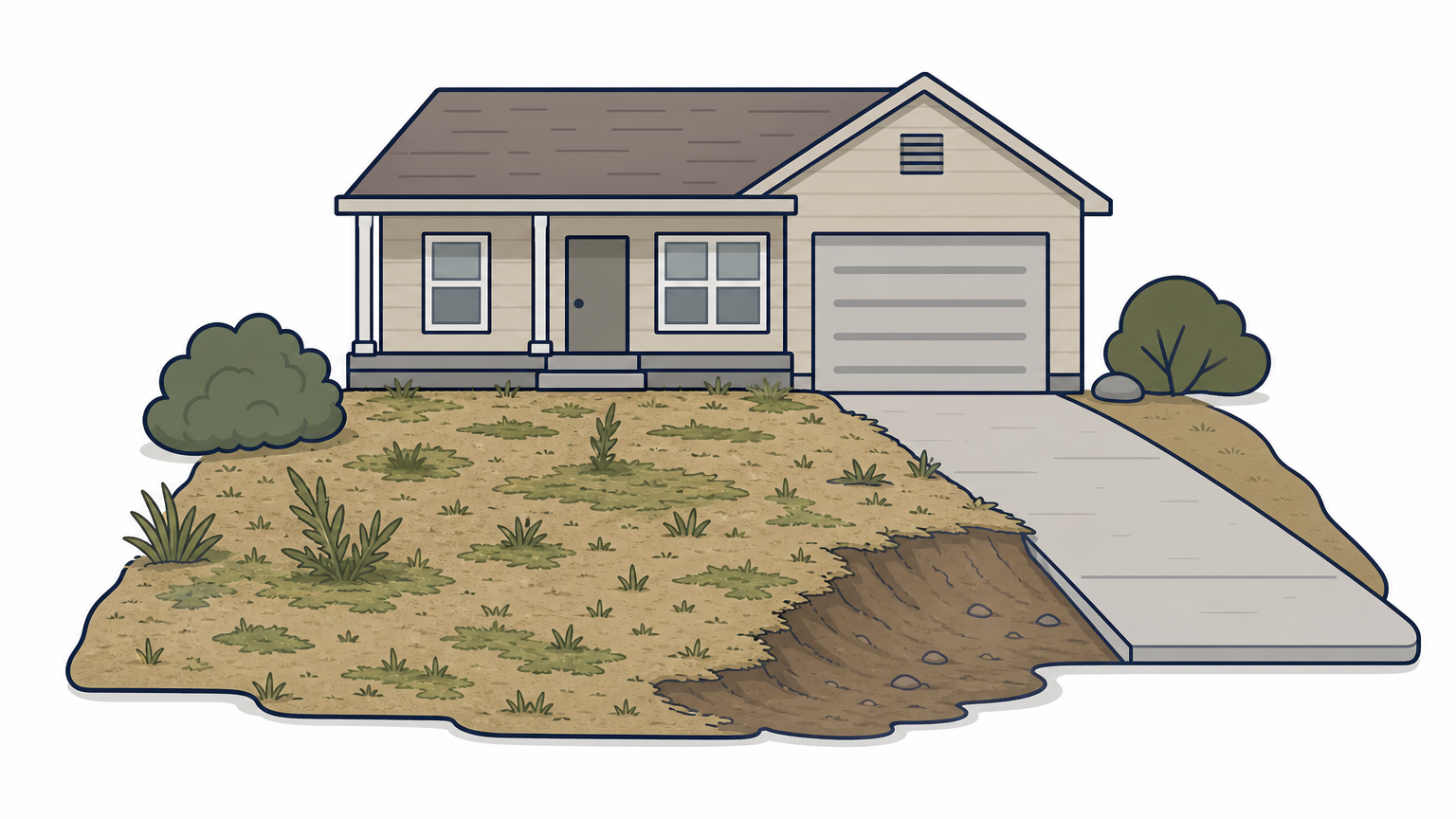
- Bare patches invite erosion , especially on sloped yards common in Blythewood and Elgin
- Curb appeal drops , which matters directly if you're selling or renting the property
Each of these problems costs more to fix later than it would have cost to prevent with steady maintenance in the first place.
A guarantee protects your investment
Hiring any lawn crew involves some risk. Maybe they no-show, maybe they scalp your grass, maybe the fertilizer application burns a section of your yard. This is where a real guarantee separates a serious company from a side hustle. Sparta Lawn Care backs every visit with a guarantee that sets a serious lawn company apart, which means the crew comes back and fixes any service issue at no additional cost until you're satisfied. That's a meaningfully different arrangement than paying upfront for a service with no recourse if the work falls short.
Properties with commercial exposure carry even more risk if lawn care slips. HOA common areas, retail frontages, and office parks all reflect on the property manager or board that hired the crew, and a patchy or overgrown lawn becomes a visible complaint at the next meeting. That's why lawn maintenance for HOAs, offices, and retail properties typically comes with tighter scheduling requirements and clearer communication than a residential-only outfit can offer. Whether you own a single home or manage a dozen common areas, the underlying reason to hire a professional stays the same: consistent, guaranteed care costs less over time than fixing what neglect breaks.
How to choose the right lawn care service company
Picking a lawn care service company shouldn't come down to whichever truck drives by first with a magnet on the door, and it helps to know how to find a dependable lawn mowing service near you. You're entering a recurring relationship with someone who'll be on your property weekly for months, so treat the decision with the same care you'd use hiring any contractor who touches your home or business regularly. A few concrete checks separate a company you'll trust for years from one you'll be replacing by July.
Verify licensing, insurance, and experience
Before anything else, confirm the company carries proper licensing and liability insurance. If a mower throws a rock through a window or an employee gets hurt on your property, an uninsured operator leaves you exposed to the claim. Ask how long the company has operated locally, since longevity in the Midlands market tells you something insurance paperwork alone can't: the crew has already survived multiple South Carolina growing seasons and knows how local turf behaves under real conditions. Sparta Lawn Care has operated as a licensed and insured, veteran-owned lawn care company for more than 20 years in Columbia, Blythewood, and Elgin, which is the kind of track record worth asking any competitor to match.
A company's insurance paperwork matters less than its track record, but you need both before you hand over a key or a gate code.
Look for crew consistency, not rotating labor
Ask directly whether the same crew returns to your property each visit, or whether you'll get whoever's available that day. Rotating labor means re-explaining your preferences constantly and losing the accumulated knowledge a familiar crew builds about your specific yard. A crew-based service model solves this by assigning the same team to the same properties week after week, so they notice small changes before they become big problems.
Compare guarantees and service scope
Read the fine print on what happens when something goes wrong. Some companies charge extra to fix their own mistakes; others, like Sparta Lawn Care's Family Guarantee, return at no additional cost until you're satisfied. Also confirm the full scope of what's included versus what's billed separately:
| What to ask | Why it matters |
|---|---|
| Is fertilization included or billed separately? | Avoids surprise line items later |
| Does the quote cover edging and cleanup? | Some quotes cover mowing only |
| What's the guarantee if something goes wrong? | Determines your recourse |
| How is payment handled? | Online portals save time and paper checks |
| Can they handle both residential and commercial needs? | Matters if you manage multiple property types |
Check payment convenience and communication
Modern lawn care shouldn't require you to leave cash under the mat or chase down a paper invoice. Sparta Lawn Care processes online credit card payments through a secure client hub powered by Jobber, letting you review service history and pay without waiting for someone to be home. Convenience like this signals a company that's invested in running a real operation, not a side gig managed from a truck dashboard. Together, these factors, licensing, crew consistency, guarantees, and payment ease, give you a practical checklist for separating a dependable lawn care service from one you'll be Googling to replace by next spring.
Lawn care vs. lawn service: what each one covers
Most homeowners use "lawn care" and "lawn service" as if they mean the same thing, but the terms actually describe two different scopes of work, and knowing the difference helps you read a quote correctly. Lawn care refers specifically to the health of the turf itself: fertilization, weed control, aeration, overseeding, and disease management. Lawn service (sometimes called lawn maintenance) refers to the recurring physical upkeep of the property: mowing, edging, trimming, and blowing off clippings. A company that only offers one of these isn't necessarily doing anything wrong, but you need to know which one you're hiring before you assume your yard is fully covered.
What falls under lawn care
Lawn care treatments target the biology of your grass and soil. This includes seasonal fertilization and weed control treatments , pre-emergent applications timed before weed seeds germinate, and what aeration and overseeding actually do for a lawn when soil is compacted or turf has thinned out. None of this involves a mower. A property can get mowed every week and still lose ground to weeds, fungus, or nutrient deficiency if nobody's handling the care side separately.
What falls under lawn service
Lawn service is the physical labor that keeps a property looking maintained on a weekly or biweekly basis. That means weekly mowing, precise edging, and cleanup at the correct height for the season, trimming around obstacles a mower can't reach, and clearing clippings and debris before leaving. It's the visible, immediate part of upkeep, but it doesn't address what's happening below the surface.
Mowing keeps a yard looking maintained; care is what actually keeps it alive and thriving underneath.
Why the distinction matters when comparing quotes
Here's where this gets practical. If two companies quote you different prices, one might be pricing lawn service alone while the other bundles in lawn care. Comparing those numbers side by side without checking scope is comparing apples to oranges.
| Service type | What's included | What it doesn't cover |
|---|---|---|
| Lawn service | Mowing, edging, trimming, cleanup | Fertilization, weed control, aeration |
| Lawn care | Fertilization, weed control, aeration, overseeding | Weekly mowing and edging |
| Full-service package | Both categories combined under one crew | Rarely excludes anything standard |
Sparta Lawn Care structures its offering so residential and commercial clients get both halves under one roof instead of juggling separate vendors for mowing and treatments. That matters because a mowing-only company has no incentive to flag a fungal outbreak or a compaction problem it isn't contracted to treat, while a single crew handling both sees the whole picture every visit. When you're requesting quotes, ask directly whether the number covers lawn service, lawn care, or both, since that one question clears up more confusion than almost anything else in the buying process.
How much does a lawn care service cost
Price is the question everyone actually wants answered, and the honest response is: it depends on your lot size, grass type, and how many services you bundle together. A lawn care service for a typical quarter-acre residential lot in Columbia or Blythewood usually runs $40 to $75 per mowing visit, while fertilization and weed control treatments are billed separately, often as a 5 to 7 application program spread across the growing season. Aeration on Columbia's heavy clay soil, paired with overseeding, is something most Midlands lawns need at least once a year and typically adds another $150 to $400 depending on square footage and whether you're seeding cool-season or warm-season turf.
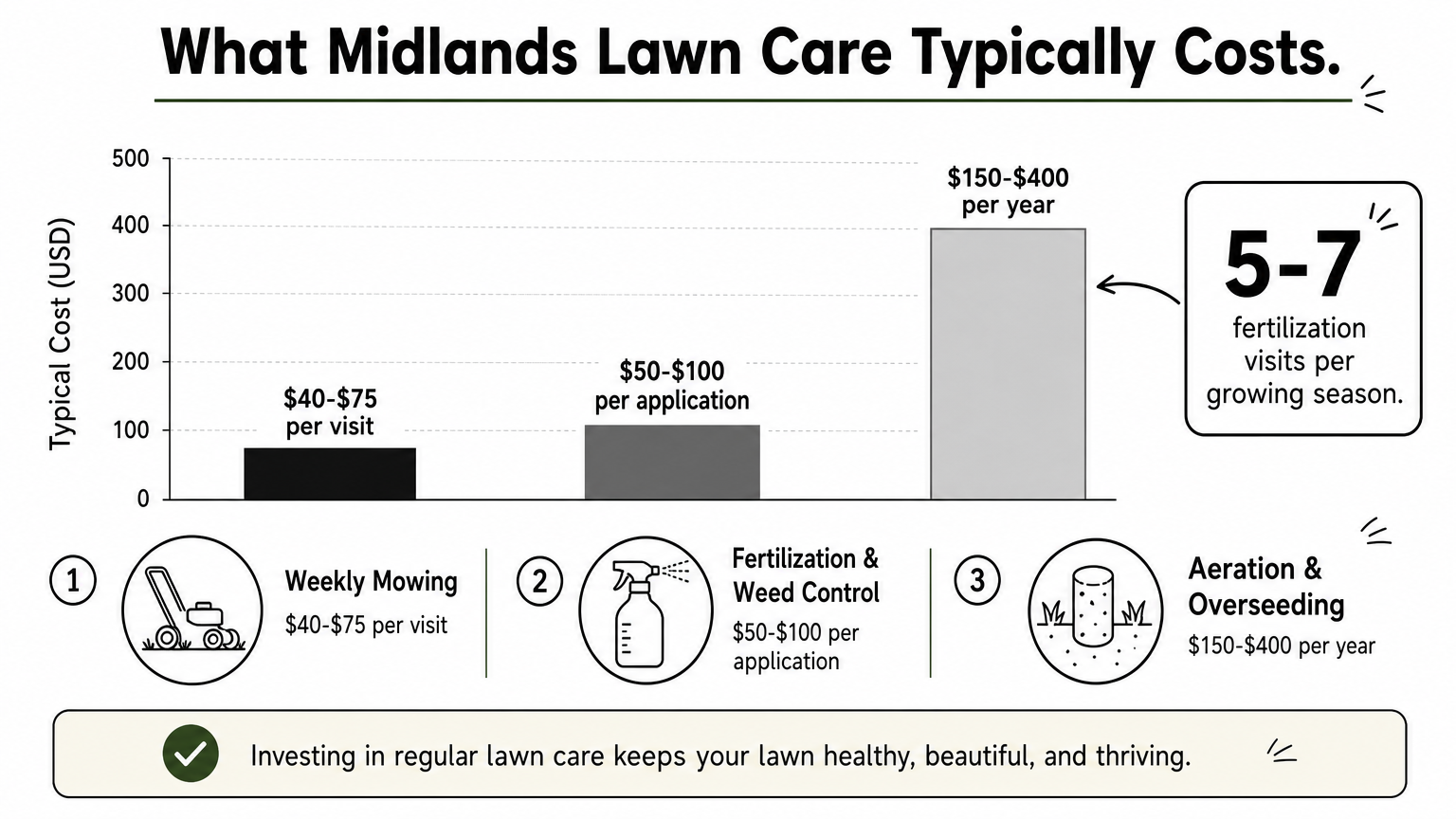
The real cost of lawn care isn't the invoice total, it's what you avoid paying later in reseeding, disease treatment, and drainage repair.
Typical residential pricing ranges
Below is a rough breakdown of what Midlands homeowners can expect to pay for common services. Exact pricing always depends on lot size, terrain, and how overgrown or neglected the property was before service started.
| Service | Typical price range | Frequency |
|---|---|---|
| Weekly mowing and edging | $40 - $75 per visit | Weekly or biweekly |
| Fertilization and weed control | $50 - $100 per application | 5-7 times per year |
| Aeration and overseeding | $150 - $400 | 1-2 times per year |
| Full-service bundle | Custom quote | Ongoing contract |
What actually drives the price up or down
Quotes swing based on a handful of concrete factors, and knowing them helps you sanity-check any estimate you receive:
- Lot size and terrain , since sloped or oddly shaped yards take longer to mow and edge cleanly
- Grass type , because centipede and Bermuda have different fertilization schedules than fescue
- Existing lawn condition , since a neglected yard often needs extra treatments before it falls into a normal maintenance rhythm
- Service frequency , weekly visits cost less per cut than sporadic scheduling once you factor in overgrowth cleanup
- Bundled services , since combining mowing with fertilization and aeration under one crew usually costs less than hiring separate vendors
Commercial and HOA pricing works differently
Offices, retail strips, and HOA common areas rarely fit a flat per-visit price. Commercial lawn care and maintenance contracts usually get quoted based on total acreage, number of buildings or common areas, and how often the property needs attention during peak growing months. A property manager overseeing several HOA sections should expect a custom proposal rather than a generic per-lawn rate, since commercial properties often need coordinated scheduling around business hours or resident foot traffic. Getting an accurate number for either residential or commercial work means requesting a walk-through quote rather than trusting a phone estimate, since no two Midlands properties grow, drain, or wear exactly the same way.
DIY lawn care vs. hiring a professional crew
Plenty of homeowners start out mowing their own yard, and there's nothing wrong with that if you've got the time, the right equipment, and a grass type that forgives the occasional mistake. But DIY lawn care has real limits once you get into fertilization timing, pest identification, and soil chemistry, and those limits show up as thin patches, weed outbreaks, or a fertilizer burn that takes months to grow out. Knowing where DIY makes sense and where it starts costing you more than a lawn care service is worth working out before you invest in a second mower.
What DIY actually requires
Before ditching a lawn service, be honest about the time and equipment DIY demands. A quarter-acre lot needs roughly an hour of mowing and edging weekly during peak growing season, plus separate time for fertilizer applications, pre-emergent weed control, and aeration once or twice a year. That means owning or renting a mower, edger, blower, spreader, and enough knowledge to identify whether your grass is centipede, Bermuda, or fescue, since applying the wrong product at the wrong time can set your lawn back rather than help it.
Owning the equipment isn't the hard part of DIY lawn care, knowing exactly when to use it is.
Where professionals pull ahead
Consider the real gap between a homeowner mowing on weekends and a crew-based service model that manages dozens of Midlands properties every week. Professionals carry commercial-grade mowers that cut cleaner and faster, they've already diagnosed fungal outbreaks and grub damage on similar yards, and they follow a fertilization calendar built around actual soil temperatures rather than guesswork. Sparta Lawn Care crews also carry liability insurance, so if equipment damages a fence or a sprinkler head, you're not the one absorbing the repair cost out of pocket.
A practical comparison
| Factor | DIY lawn care | Professional lawn care service |
|---|---|---|
| Time commitment | 1-3 hours weekly, more during peak season | Zero, crew handles scheduling |
| Equipment cost | $300-$1,500+ upfront, plus maintenance | Included in service price |
| Treatment timing | Self-researched, trial and error | Calendar-based, locally tested |
| Risk if something goes wrong | You absorb the cost | Covered under service guarantee |
| Consistency | Depends on your schedule | Same crew, same schedule weekly |
When DIY still makes sense
Small lots, flat terrain, and an owner who genuinely enjoys yard work can make DIY a reasonable choice, especially if you're not managing fertilization or aeration on your own and only handling the mowing. Where DIY breaks down is on larger properties, sloped yards, or any lawn that's already showing signs of disease or compaction, since those situations need diagnostic experience most homeowners haven't built up. Commercial properties and HOA common areas aren't realistic DIY candidates at all, given the acreage and liability involved. If you're weighing the two options and leaning toward handing it off, that's usually the point where a residential lawn care and maintenance plan starts paying for itself in saved weekends and healthier turf.
Questions to ask before hiring a lawn care company
Getting a fair quote from a lawn care service company depends on asking the right questions upfront, not after you've already signed a contract. Most homeowners call two or three companies, compare the bottom-line number, and pick the cheapest one, then wonder later why the cheap option kept skipping visits or billing for extras nobody mentioned. A short list of pointed questions during that first call saves you from most of the surprises that show up three months into a service agreement.
Questions about scope and scheduling
Start by confirming exactly what's included in the quoted price, since "lawn care" means different things to different companies, as covered earlier. Ask whether the price covers mowing, edging, and cleanup, or whether fertilization and weed control get billed as add-ons. Then nail down scheduling specifics, because a company that's vague about visit frequency is usually a company that shows up whenever it's convenient for them, not you.
- Does the quote include mowing, edging, and cleanup, or just one of those?
- How often will the crew actually visit during peak growing season?
- Will the same crew return each time, or does labor rotate?
- How does the company handle scheduling around rain or holidays?
- Is fertilization and weed control priced separately, and on what schedule?
Questions about pricing and contracts
Next, get clear on the financial side before you commit to anything. Contracts that lock you in for a full year without an easy exit clause put all the risk on you if service quality drops. Payment method matters too, since a company still running on paper invoices or cash-only collection is usually behind on the operational side of the business as well.
If a company can't clearly answer how much you'll pay and when, that's the answer you needed before you signed anything.
| Question | Why it matters |
|---|---|
| Is pricing per visit or a flat monthly rate? | Affects your budget predictability |
| Are there cancellation fees or long-term lock-in? | Limits your flexibility if service disappoints |
| Can I pay online through a secure portal? | Signals a professionally run operation |
| Are estimates based on a walk-through or a phone guess? | Phone-only quotes are often inaccurate |
Questions that reveal red flags
Finally, ask a few questions specifically designed to expose a company that isn't set up to handle real problems. Request proof of licensing and insurance directly, and don't accept a vague "we're covered" without documentation. Inquire what happens if the crew damages a sprinkler head, scalps a section of turf, or simply doesn't show up on a scheduled day. Sparta Lawn Care answers that last one with the Sparta Family Guarantee , returning at no extra cost until the issue is resolved, and any company worth hiring should have a comparably clear answer ready without hesitation. Vague answers, reluctance to provide proof of insurance, or pressure to sign a long contract before a single visit are all signs to keep calling around.
Seasonal lawn care needs in Columbia and the Midlands
Weather in the Midlands doesn't move in a straight line, and neither should your lawn care schedule. Columbia's hot, humid summers and mild winters mean warm-season grasses like Bermuda and centipede dominate most yards, but that also means your lawn's needs shift dramatically every few months. A lawn care service that applies the same treatment year-round, regardless of season, is guessing rather than managing your turf. Understanding what each season demands helps you judge whether a company's schedule actually matches how grass grows here, or whether they're running a generic national playbook that ignores South Carolina's climate.
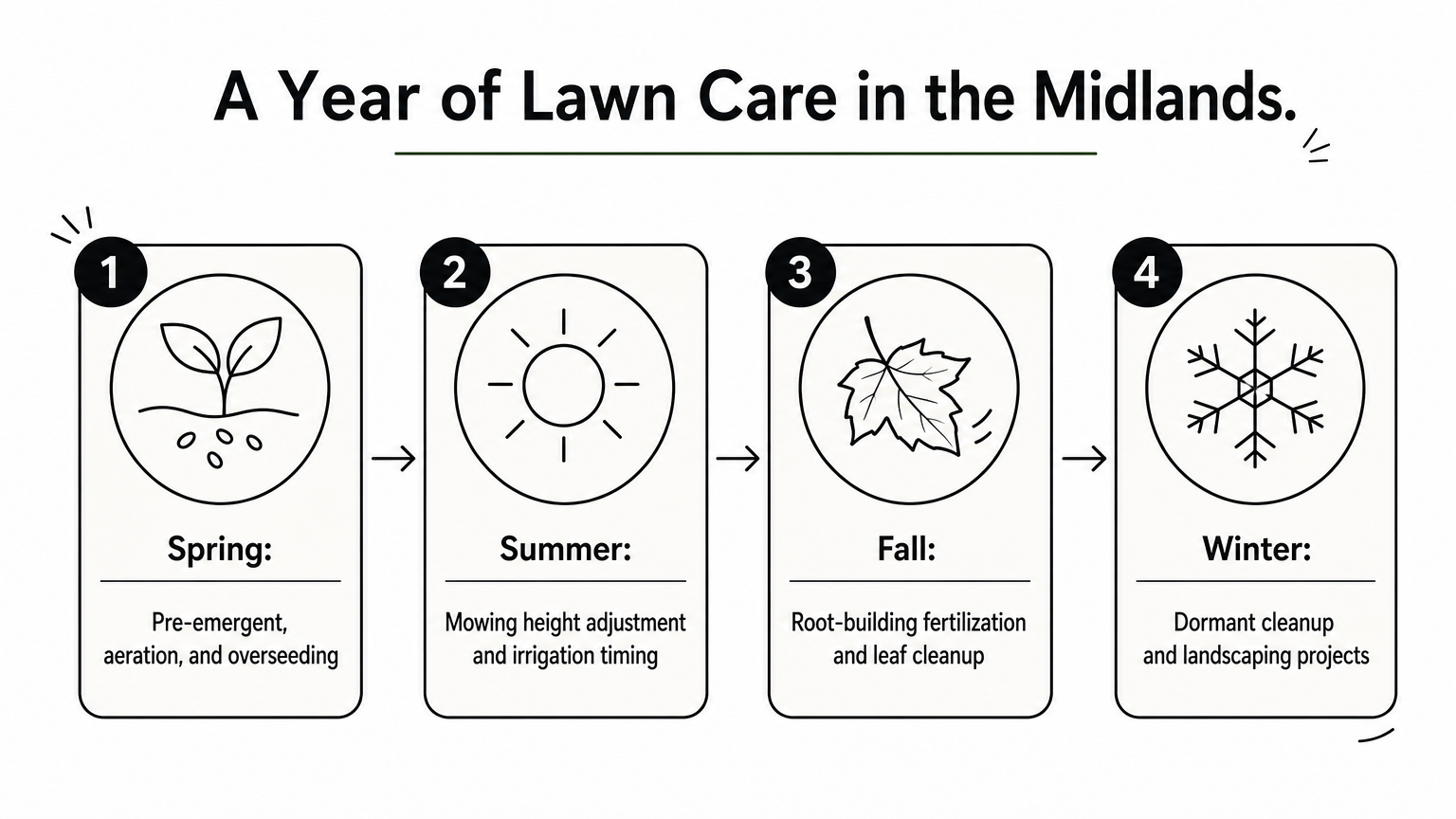
Spring green-up and pre-emergent timing
Spring is when dormant warm-season grass wakes up, and it's also your narrow window for pre-emergent weed control in Columbia before crabgrass and other summer weeds germinate. Miss this application by even two weeks and you're fighting weeds all summer instead of preventing them. Aeration and overseeding, where timing and grass type decide the result, often happen in late spring too, once soil temperatures climb enough for warm-season grass to recover quickly from the process.
Spring pre-emergent timing determines whether you spend summer preventing weeds or fighting them.
Summer heat stress and mowing adjustments
High temperatures and heavy humidity through June, July, and August put real stress on turf, and mowing height and timing for Bermuda and Zoysia lawns need to shift slightly to protect roots from scorching soil. Irrigation timing matters more here than in any other season, since watering during peak afternoon heat wastes water and can encourage fungal disease. Regular fertilization and weed control treatments during summer focus on feeding the grass without pushing excessive growth that outpaces your mowing schedule.
Fall fertilization and cleanup
Fall is arguably the most important season for next year's lawn, since lawn fertilization timed to the season in Columbia, SC builds root reserves that carry warm-season grass through winter dormancy. Cleanup also ramps up as leaves drop, and a crew that handles both mowing and fall leaf removal in one visit saves you from a yard buried under wet leaves for weeks. This is also when many Midlands homeowners start planning holiday and Christmas lights and comparing what holiday light installation costs, since booking early avoids the scheduling crunch that hits every crew in November.
Winter dormancy and holiday projects
Winter slows turf growth to a crawl, but that doesn't mean your property goes untouched. Dormant-season cleanup, mulching, and residential landscaping installations often happen now, since crews aren't racing weekly mowing schedules. Property owners tackling larger cleanup or landscaping projects during this slower stretch frequently need a dumpster trailer rental to haul debris, especially when clearing beds or removing dead shrubs before spring planting.
| Season | Priority tasks |
|---|---|
| Spring | Pre-emergent, aeration, overseeding, green-up fertilization |
| Summer | Mowing height adjustment, irrigation timing, weed control |
| Fall | Root-building fertilization, leaf cleanup, holiday light booking |
| Winter | Dormant cleanup, landscaping projects, debris removal |
A company that can walk you through this calendar without hesitation understands Midlands turf. One that can't is applying guesswork to your yard.
What this means for your lawn
A healthy Midlands lawn comes down to timing, consistency, and knowing exactly what you're paying for. You now know the difference between lawn care and lawn service, what fair pricing looks like for your lot size, and which questions expose a company that's cutting corners. That knowledge puts you ahead of most homeowners who just call whoever answers first.
What happens next matters more than what you've read. Grass doesn't wait for you to decide, and every skipped mowing or missed fertilization window pushes your yard further from where it should be. A reliable lawn care service backed by a real guarantee costs less over a season than fixing what neglect breaks. If you're ready to stop guessing and get a crew that actually shows up, request a free lawn care quote in Columbia and get your yard on a schedule built for how grass grows here.