

Lawn Mowing Service Price: What You Should Expect to Pay
You want a mowed lawn without getting ripped off, but every quote you get seems to land in a different price range. One company quotes $35, another says $75, and you have no idea which one actually matches the size and condition of your yard. That guessing game is exactly why so many Columbia and Blythewood homeowners search for a straight answer before picking up the phone.
Here's the short version: lawn mowing service price typically runs between $30 and $80 per visit for an average residential lot, though your final number depends on lot size, grass height, terrain, and how often you schedule service. The cost lawn mowing service providers quote also shifts based on whether you're booking a one-time cleanup or a season-long maintenance plan.
In this article, we break down what drives those numbers, from acreage and access to trip charges and add-ons like edging or bagging clippings. We'll also cover what's typical for the Midlands region of South Carolina, so you can compare quotes with confidence and know what a fair price actually looks like before you sign up with a crew.
Why lawn mowing prices vary so much
Ask five lawn care companies for a quote and you'll likely get five different numbers, and that's not because someone's trying to overcharge you. Lawn mowing service price swings widely because what a mowing service actually includes isn't a single, standardized job. A quarter-acre flat lot in a subdivision takes 15 minutes to knock out. A half-acre property with a slope, tree roots, and a fence line to trim around can eat up 45 minutes or more. Every variable adds or subtracts time, and time is what you're actually paying for.
Lot size and grass type
Size is the biggest lever. Most companies price per visit based on square footage, and the jump from a 5,000 square foot yard to a 15,000 square foot yard isn't small. Grass type matters too. Bermuda and zoysia grow fast and thick in South Carolina's heat, which means more clippings, more mower resistance, and sometimes a second pass to get a clean cut, so when and how often to mow Bermuda and Zoysia lawns changes through the season. Fescue lawns, common in shadier parts of the Midlands, tend to grow slower and mow easier, which can keep costs a bit lower during the cooler months.
Terrain, obstacles, and access
A flat, open lawn is the cheapest thing a crew can mow. Add a steep slope, and the crew either has to use a push mower where a rider would normally work, or take extra time and care to avoid scalping or slipping. Obstacles like flower beds, retaining walls, playground equipment, and narrow side-yard gates all slow the job down because the crew has to maneuver around them by hand or with a smaller trimmer. Fenced backyards with a single narrow gate can also mean a crew has to carry equipment in rather than drive it, which adds labor time that shows up in your quote.
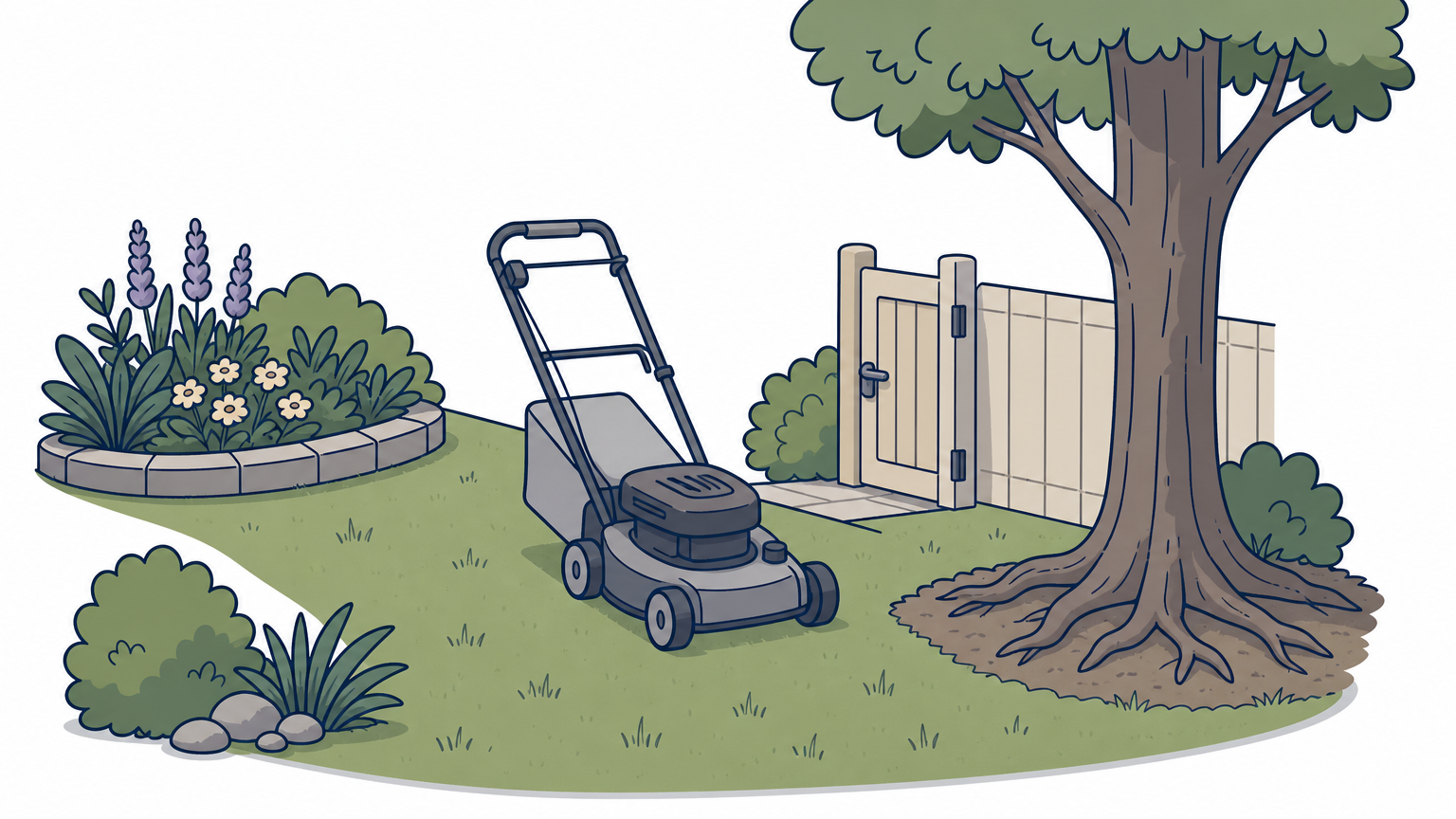
The single biggest reason two quotes for the same yard can differ by $20 or more usually comes down to how long the job actually takes, not how much a company wants to charge.
Frequency and contract length
Homeowners who book weekly or biweekly service almost always pay less per visit than someone booking a one-time mow. Recurring customers keep grass at a manageable height, so each visit is faster and more predictable for the crew. A yard that's gone a month without cutting, on the other hand, often needs a longer mowing time, extra bagging because clippings are too thick to leave on the lawn, and sometimes a follow-up trip to haul away debris. That's why a cost lawn mowing service quote for a first-time overgrown lawn can run noticeably higher than the recurring rate you'd pay once you're on a regular schedule.
Regional labor and travel costs
Where you live inside the Midlands region also plays a role. Crews servicing dense neighborhoods in Columbia can hit more properties per day, which spreads their overhead across more jobs. Properties farther out toward Elgin or rural stretches near Blythewood may carry a small trip charge to cover drive time and fuel, especially for one-off jobs. None of this is arbitrary. It reflects the same cost structure any service business deals with, and it's worth understanding before you compare quotes side by side.
| Factor | Impact on price |
|---|---|
| Lot size | Larger lots take longer, higher per-visit cost |
| Grass type | Bermuda/zoysia often costs more than fescue in growing season |
| Terrain/obstacles | Slopes, beds, and tight access add labor time |
| Frequency | Weekly/biweekly plans usually beat one-time rates |
| Distance from crew base | Rural or outlying properties may carry a trip fee |
Once you understand these variables, a $35 quote and a $75 quote for what looks like a similar yard start to make sense. They're rarely measuring the same job.
How to estimate your lawn mowing costs
Start by walking your own property before you call anyone. Pull up your county's GIS or property tax website, or use a phone app that measures square footage, and get an actual number for your lot size rather than guessing. Most quotes are built around square footage, so a rough guess of "about half an acre" can throw off a phone estimate by hundreds of dollars either way. Write down the total lawn area, not the whole parcel, since driveways, house footprint, and gravel beds don't count toward mowing time.
Next, take stock of what makes your yard harder or easier to mow than a flat, open rectangle. Note any slopes steep enough that you'd hesitate to push a mower up them yourself, count the flower beds and trees you'd need to trim around, and check whether gates or fences would force a crew to carry equipment in by hand. These details matter more than most homeowners expect.
A five-minute walk around your yard with a notepad will get you a more accurate cost estimate than any online calculator.
After that, decide how often you actually want service, since mowing frequency changes the math more than almost anything else. A weekly plan during peak growing season keeps grass short and manageable, which keeps each visit fast and cheap. Skipping to a monthly or as-needed schedule almost always means a longer, messier first cut and a higher price tag to match.
Finally, request quotes from at least three local providers using the same details for each one: exact square footage, desired frequency, and any known obstacles. Ask each company to break down what's included so you're comparing full plans, not just a bare number. A useful way to organize this before you call:
- Measured lawn square footage (not total lot size)
- Grass type, if you know it (fescue, Bermuda, zoysia)
- Slope or terrain notes
- Number of beds, trees, or obstacles to trim around
- Gate width and backyard access
- Preferred frequency (weekly, biweekly, one-time)
Bring that same list to every call and you'll get quotes you can actually compare apples to apples. If you'd rather skip the guesswork entirely, Sparta Lawn Care can walk your property and give you a firm number based on what your yard actually needs, not a generic per-acre rate.
Typical price ranges by plan and lawn size
Numbers help more than ranges when you're trying to budget, so here's what homeowners across Columbia, Blythewood, and Elgin typically pay once you factor in lot size and how often service happens. These figures reflect a standard flat lot with no major obstacles; slopes, heavy shade grass, or overgrowth push the price toward the higher end of each range, and full-program pricing follows the same logic if you're wondering how much a lawn care service costs in 2026.
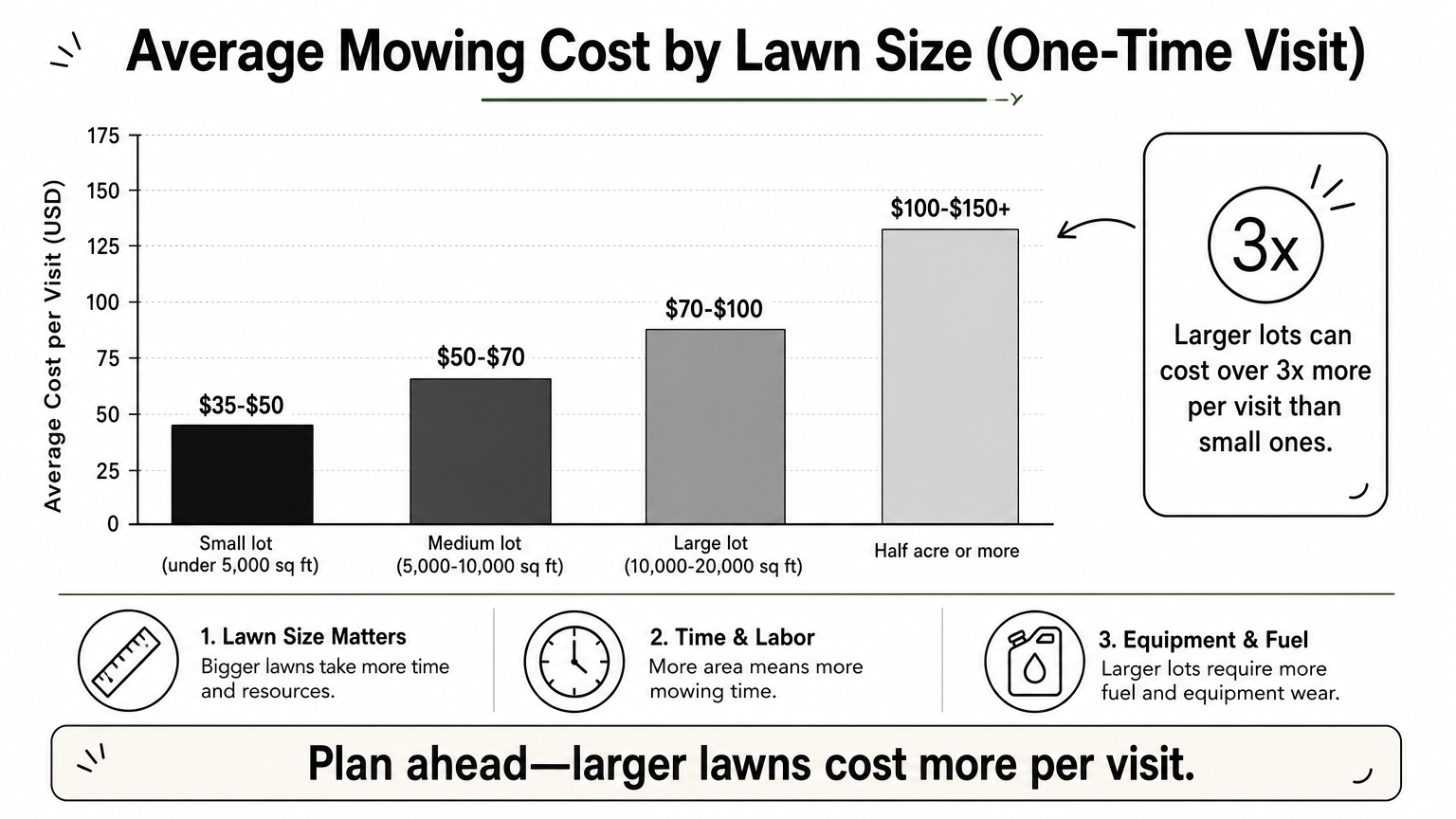
| Lawn size | One-time mow | Weekly/biweekly plan |
|---|---|---|
| Small (under 5,000 sq ft) | $35-$50 | $30-$40 per visit |
| Medium (5,000-10,000 sq ft) | $50-$70 | $40-$55 per visit |
| Large (10,000-20,000 sq ft) | $70-$100 | $55-$75 per visit |
| Half acre or more | $100-$150+ | $75-$110+ per visit |
Recurring plans versus one-time mows
Signing up for a recurring maintenance plan almost always beats paying for one-time visits over the course of a season. Crews already know your property after the first couple of cuts, which shaves time off every visit after that. A homeowner paying $45 per week for 30 weeks spends roughly $1,350 for the season, while the same yard booked as a series of one-time visits at $65 each would run closer to $1,950 for the same number of cuts. That gap covers a real cost difference, not just a sales incentive.
Booking a recurring plan instead of one-time mows can save you several hundred dollars over a single growing season.
Commercial and HOA property pricing
Commercial lots and HOA common areas price differently because size and layout vary so much from one property to the next. A small office park with a tidy quarter-acre of grass might run $60-$90 per visit, while a large HOA with multiple green spaces, entrance islands, and detention ponds can run into the hundreds per visit. Property managers usually get better rates on commercial and HOA lawn maintenance through a season-long contract than through ad hoc requests, since a crew can schedule the property alongside neighboring jobs and cut down on drive time.
Seasonal price shifts
Expect prices to flex a bit with the calendar. Fescue lawns often need less frequent cutting in peak summer heat, which can lower your per-month total even on a recurring plan. Bermuda and zoysia, on the other hand, grow fastest in South Carolina's summer months and may need weekly cuts to stay ahead of it, even if you switch to biweekly service in spring and fall.
What's included versus what costs extra
A quoted lawn mowing service price rarely tells the whole story until you know what's baked into that number. Some companies bundle edging and blowing off hard surfaces into every visit, while others treat those as separate line items you'll notice on your first invoice. Before you compare two quotes side by side, ask what a "standard mow" actually covers, because that single question can explain a $15 gap faster than anything else.
What a standard visit usually covers
Most reputable crews include cutting at a consistent height, string trimming around obstacles, and blowing clippings off driveways and sidewalks as part of the base price. Bagging clippings is sometimes included and sometimes an upcharge, especially if your grass is thick Bermuda or zoysia that produces heavy clumps. Here's a quick breakdown of what typically falls inside a standard mowing visit versus what usually gets billed separately:
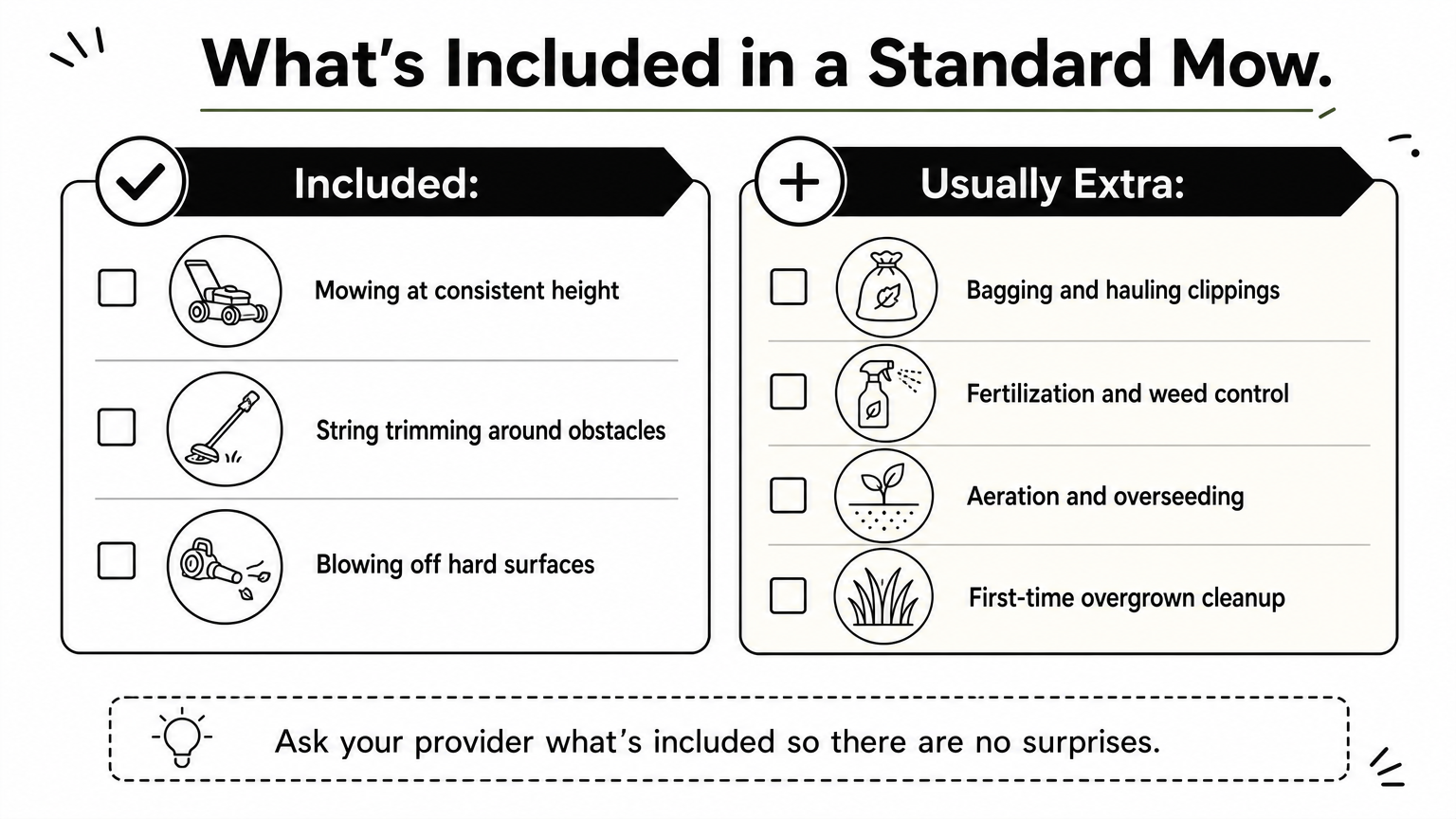
- Included: mowing, string trimming, blowing off hard surfaces
- Often included: light edging along driveways and walkways
- Usually extra: bagging and hauling clippings
- Usually extra: fertilization and weed control treatments
- Usually extra: aeration and overseeding
- Usually extra: first-time cleanup for overgrown lawns
If a quote seems unusually low, ask what's excluded before you assume you found a bargain.
Add-ons that push the price higher
Beyond the base mow, most Midlands homeowners eventually add a service or two to keep their lawn healthy through the year. Fertilization and weed control treatments run on their own schedule, separate from mowing, and typically get billed per application rather than folded into your weekly rate. Aeration and overseeding work the same way, usually scheduled once or twice a year in fall or spring rather than priced into a mowing plan. Holiday lighting installation and dumpster trailer rentals fall into this same bucket: useful add-ons when you need them, but not part of a standard mowing contract.
Why the fine print matters
Getting a clear answer up front saves you from an invoice that looks nothing like the quote you agreed to. Providers who spell out exactly what's included, and price add-ons transparently, tend to be the ones worth sticking with long term. Sparta Lawn Care builds its lawn care fertilization and weed control and aeration and overseeding services as clearly separate line items from mowing, so you always know what you're paying for and why, rather than discovering surprise charges mid-season.
How to choose the right lawn care provider
Price matters, but it shouldn't be the only thing you weigh when picking a crew for your yard. Picking a lawn care provider based on the lowest number alone often backfires when that company cuts corners on trimming, skips weeks during peak growth, or shows up with different workers every visit who don't know your property. The cheapest quote and the best value are rarely the same thing, and figuring out which company actually delivers consistent results takes a little more digging than comparing three numbers on a page.
Check licensing, insurance, and reputation
Before you sign anything, confirm the company is licensed and insured in South Carolina. This protects you if a mower kicks up a rock and cracks a window, or if a worker gets hurt on your property. Ask how long the business has operated locally, since a company with 20+ years in the Columbia and Blythewood area has weathered enough seasons to know how South Carolina heat, drought, and heavy summer rain affect turf. Read a handful of recent reviews, not just the top three, and look for patterns around reliability and communication rather than isolated complaints.
A lawn care company's history of showing up on schedule tells you more than any advertised price ever will.
Ask about crew consistency and guarantees
Find out whether the same crew services your property every visit or whether you'll get whoever's available that day. Crew consistency is one of the clearest signs of a good mowing company, because familiar workers learn your yard's quirks, like which bed edges need extra care or where a sprinkler head sits low in the grass. Also ask what happens if you're unhappy with a mow. A company willing to fix an issue at no extra charge, rather than shrugging and moving on to the next job, is signaling that it stands behind its work.
Before you commit, run through a short checklist with each provider you're considering:
- Are you licensed and insured in South Carolina?
- Will the same crew service my property each visit?
- What's included in a standard mow, and what costs extra?
- How do you handle a missed spot or a complaint?
- Can I pay online, and what's your billing schedule?
Sparta Lawn Care answers all five with a crew-based model, the guarantee behind every visit, and secure online payments through its client hub, which is exactly the kind of transparency worth looking for wherever you end up hiring.
Getting a lawn you're happy to pay for
At this point, the wide range of quotes you started with should make a lot more sense. Lawn mowing service price isn't random. It reflects lot size, terrain, grass type, frequency, and exactly what's bundled into a standard visit. Once you measure your yard, list its quirks, and ask the right questions, you can spot a fair number from an inflated one in a single phone call.
Good value doesn't mean the cheapest quote on your list. It means a crew that shows up on schedule, prices things clearly, and fixes problems without a fight. That's worth more than saving five dollars a visit with a company that skips weeks or sends different workers every time.
If you're ready to stop comparing guesses and get a real number for your property, request a free mowing estimate from Sparta Lawn Care, backed by 20 years of local experience and a guarantee that stands behind every mow.